Showing posts with label PCs. Show all posts

Tuesday, November 12, 2013

Encounter Design, Pt. 3: Effective Use of Mooks

It's been a while since last time (sorry, I've been busy)! Last time we looked at how to deal with lots of enemies with lots of abilities in high level encounters. Today I'm going to discuss using lots of weak enemies in higher level games.

When used creatively, mooks can challenge and inspire players.
Due to the way scaling in d20 games such as D&D or Pathfinder works, a lot of people think that using low challenge-rating creatures quickly becomes pointless in challenging or entertaining players. Today I'm going to challenge that idea during our encounter design. Let's get started!

Defining a Mook
Before we go any further, I'm going to be using the term "mook" a lot in this article so it's important that I explain what I mean when I say "mook". In this context a mook is any antagonist who offers little to no threat to the party on their own. Specifically, a mook is an enemy who's much lower in level/CR than the protagonists. Mook is a relative term. A 1st level orc warrior may be a formidable opponent in its own right to a 1st level party, but it's likely well into mook territory by the time the party is 5th level, and little more than a speed-bump in the path of an 11th level character. Suffice to say that mooks rarely pose much of a danger to the protagonists on their own.


Mook Misconceptions
It's commonly believed that mooks are not good tools for the GM to use to challenge his or her players in most d20 games like D&D 3.x or Pathfinder. This belief isn't entirely unjustified. The basic theory is that as player characters advance in experience and power their statistics reach a point where low level enemies pose less of a threat. An orc who threatened to injure a character 50% of the time may have no more than a 5% chance to injure the same character several levels from now (as characters improve their armor and wear magic items like amulets of natural armor or rings of protection), so when the enemies are dispatched easily and no longer seem to offer a threat with simple attacks it can seem like they are no longer useful.

In a sense, this is true. An orc that has a +4 to hit is a great danger to a low level character, but once their AC is 24 or better, the orc can barely injure them on its own, and will probably be effectively brushed aside by the character it's fighting.

But what's important to remember is that this lone orc is not meant to be the same kind of challenge that it was at low levels. What kind of challenge it is varies depending on its role in the scene you want to present and the level of the characters that it is meant to challenge, and who it is working with.

The Strengths of the Mook
By its very definition a mook cannot be very strong individually. However the mook is a strong tool in the GM's arsenal. Mooks work best when used in groups, often when they can support one or more stronger lead antagonists, though encounters consisting entirely of mooks can be both challenging and rewarding if played right. Mooks are also very good at setting a scene or making your players feel and rejoice in their advancement as they see enemies who were once dangerous falling to the might of their newfound strength and skill, which can make mooks a useful tool for encounters where you want the players to feel awesome.

Mooks function as excellent filler enemies for encounters. Since they are worth relatively little experience points to parties they can be used as a sort of action-prop for encounters. You can often throw mooks into the mix to spice up an encounter without overloading the difficulty or experience point rewards for the event.

Mooks are expendable. Players are intended to be able to dispatch mooks quickly and efficiently. They can be used to "soak" attacks and spells of the players. When an individual mook drops in combat there is no great loss on the side of the antagonists (though you can feel free to ham it up, especially if the mook is still somehow significant to one of the more powerful antagonists, such with Au'hare and his daughters from the previous article).

Mooks can be dangerous in numbers. The thing about mooks is they can often take advantage of some tactics that are especially effective in large numbers, including using actions like Aid Another, or "dog piling" enemies with alchemical weapons, nets, flanking, and so forth. Since the addition of Teamwork Feats like Allied Spellcaster and Precise Strike the tactical options available to mooks are now much stronger and in some cases can cause them to be dangerous in their own right.

Mooks are great at supporting more serious threats. In a high level encounter, mooks can support more powerful antagonists by slowing down the protagonists, covering the big bad, or in some cases forcing the party to make tough decisions about whether to take out the mooks first (giving the big bad more time for his or her machinations) or go for the big bad first (which may give the mooks free passes to antagonize, pester, or even threaten the lives of the party themselves). In some encounters, that choice is a lot harder than most would expect!

It looked smaller in the distance...
Making Mountains out of Molehills
One of the objectives when using mooks is to use their numbers and surroundings to their advantage. Mooks are excellent targets for consumable magic items, wide-reaching buffing spells, and just throwing lots of enemies at the group at one time. Even in small packages, these little guys can pack a punch!

Let's look at a few low CR groups of mooks and their tactics. These basics, once learned, can be applied to all kinds of encounters.

Madam Elsa and her Cats (CR 1): Madam Elsa is a creepy old lady at the edge of a village. A widow whose husband died mysteriously, she now keeps lots of stray cats from the neighborhood. She seems the kindly sort, especially to strangers, though she keeps to herself. She has eight cats that stick around her house and herself. Little does the party realize she's actually an evil hedgewitch that preys on the unsuspecting travelers whom she offers a warm bed to. She uses the bodies of her victims for some dark rituals to some evil hag goddesses, and keeps their eyes on a pickle jar in her downstairs study (which remains locked).

Madam Elsa is a venerable 1st level Adept with twenty cats. However, the crazy witch has used her Handle Animal skill to train all of the housecats to be vicious killers (no really, the cats are trained to kill people) and guard her home for her. When the reveal is made, Madam Elsa commands her cats to attack her victims. During the encounter she casts bless to grant herself and her kitties granting each a +1 bonus on attacks. She then casts spells such as cause fear on key enemies.
Something like this, but angrier!

When Madam Elsa gives her command, the cats rush the party. Each cat tries to enter the space of a PC to begin scratching them. Any cat that takes 1 or more points of damage becomes spooked and flees the encounter for its life (the cats only have about 2-3 hp). Using alchemical splash weapons or spells like burning hands can be handy in this encounter.

In this encounter, the cats are the mooks. Each cat is something of a joke combatant. However, each has a +4 bonus to hit (+5 with bless), a decent AC, and three attacks per round (each dealing 1 nonlethal damage if they hit with an attack). In large enough numbers, these cats can actually be dangerous to some unsuspecting players, especially if a surprise round begins with the cats dog-piling a victim (no joke intended). Each cat is expendable, and the party must defeat no less than twenty one opponents which means that even counting opportunity attacks taking out the kitties, the encounter will probably result in more than a little catscratch fever.

Notice: The key thing to learn from this encounter is that numbers can matter. Even if every member of a four person party drops an enemy on their turn, they're still outnumbered and taking fire. Further, though it might seem mild, the simple act if casting bless can make these weenies land far more attacks.

Update: I was recently made aware that Cats actually have a monetary value in Pathfinder, which can be found here. Apparently they were listed in the Adventurer's Armory. As a result I updated the CR to being only 1, for Madam Elsa plus three cats and included the rest of her cats as part of her NPC gear. The encounter is better this way I think because CR 3 was a bit much for an old lady and her eight cats. Now there's more cats (which means more fun during the encounter) and you can assume the Madam has a few trinkets lying about her house in which to pester the PCs with (using the remainder of her 1st level NPC gear to account for them). For a gold piece Madam Elsa could own up to 33 cats, so you can feel free to add more in if you like. It won't even scratch her NPC wealth.

Orc Shaman and Goons (CR 1): A simple trio of orcs on patrol, this group consists of a single orc adept and two orc warriors. The adept has the bless spell prepared and a few cantrips, carries a longspear, wears studded leather armor, and keeps a sling handy. The adept also has a few flasks of alchemist fire the orcs call "dragon piss". The orc warriors are wearing splint mail, and wielding glaives, and each carries a flask containing a potion of enlarge person or "og'jog juice" as they call it.

Their tactics are simple. The adept casts bless on them, the orcs drink their potions, and the two big ones fight everything with their expanded reach and massive strength (when under the effects of enlarge person and bless the orcs have a 19 Strength, a +6 to hit, 20 ft. of reach with their polearms, and deal 2d8+6 damage per swing with a x3 critical damage multiplier), and can flank with each other in many cases due to their extended reach (giving them a net +8 to hit when flanking). The adept after casting his spell can use his own longspear to poke and prod at enemies while the bigger orcs protect him, or he can use Aid Another actions to give the bigger orcs another +2 bonus to hit against an enemy, or try to help line up flanking attempts.

This is a simple CR 1 encounter. The whole thing could be easily dealt with with a sleep spell or with ranged weapons (or by running long enough for the potions to wear off), but we can see that with their shared tactics and good use of consumables they would probably be taken seriously even by 5th or 6th level player characters, or should be, since they can still hurt you really bad.

Notice: The key thing to learn here is teamwork and choice in tactics can greatly influence an enemy's threat potential. By using such synergistic tactics (buffing their already impressive strength and reach, as well as improving their chances to hit with spells and actions) they are demanding the fight be fought on their terms.

Kobold Commandoes (CR 1): A quartet of kobold insurgents scurry about the small tunnels of their lair, having arrived to deal with some pesky adventurers invading their home. These kobolds are used to guerrilla-warfare style combat and skirmishing, so each has the feat Point Blank Shot instead of Skill Focus (Perception), and each carries a few flasks of alchemist fire as part of their arsenal of NPC gear.

Let's not get carried away now...
Using Stealth to its fullest potential, when combat breaks out the kobolds attempt to dogpile an enemy within 30 ft. with their alchemical bombs. Thanks to Point Blank Shot, each flask has a +1 to hit and +1 to damage, and they're throwing them at the victim's touch-armor class (so armor and shields are not helpful). The four kobolds together can inflict up to 4d6+4 fire damage to a single victim, who will burn for another 4d6 fire damage on the following turn.

Notice: The key thing to learn here is that using dogpile tactics can make things that would hurt a little bit hurt a lot. Having multiple mooks use attacks that are easy to hit with, or deal some damage regardless of the success of their hit (such as with spells like burning hands or fireball or even alchemical splash damage), or can hinder their foes (weapons such as Nets which entangle foes or tools such as tanglefoot bags or caltrops), can all be very potent in large numbers.

Using Mooks In High Level Games
The basic tools of the mooks are the same. However, smart players will all but immunize themselves to low level mook strategies by high levels (which is a good thing, because the mooks could easily kill them if they didn't). For example, the kobolds throwing alchemist fire would be deadly, except the party has equipment granting them fire resistance 10, making them harmless. Throwing nets and tanglefoot bags may be pretty pointless when your party's ranger has freedom of movement keeping him going. All the potions in the world might not help against a party filled with superheroes.

But that's okay, because like I said before, mooks are relative. At 17th level, a party could easily consider an erinyes to be a mook (she's about 10 Challenge Ratings beneath the party's level, and by herself wouldn't even be worth experience points), but she can be excellent support to a large big bad and very dangerous in large numbers (she can cast unholy blight every round for 5d8 nonelemental damage, save for half, which can hurt if you get pelted with enough of them, and could make concentrating on spells very difficult).

Once parties have gotten to high enough levels, the very low level mooks (such as orcs and goblins) can still be used as narrative tools or even in encounters, just not as true combatants. Instead, they can be used as support, using Aid Another for their masters, or preferably by giving players objectives and choices in combat. For example, when the 11th level party is fighting the big bad, perhaps the villain shouts "Release the Kraken!" or something equally terrible, and then lots of goblins begin making their way up a long staircase to reach a lever to release a big monster from a pen. Now the party has to decide whether or not to split their attention trying to pick off goblins moving up the stone stairway in single file or deal with the current threat and hope that they're ready for whatever comes out next!

Putting it All Together

So let's take everything we've been reading here and put it all together into a high level encounter utilizing mooks. In today's plot, we're going to have a powerful drow priestess  and an entourage of drow adept acolytes who use dogpile tactics, and an assortment of drow warriors who pester and hinder the party until they are dealt with.

CR 14 Encounter (38,400 XP Budget)
  • CR 12 x1: Level 13 Drow Cleric priestess x1 (19,200 XP)
  • CR 4 x12: Level 9 Drow Adept acolyte x12 (14,400 XP)
  • CR 2 Trap x1: Intelligent magic trap that casts a random 2nd level spell chosen from a list each round x1 (600 XP)
  • CR 1/3 x 30: Drow warriors x30 (4,050 XP)
Total XP: 38,250 XP (150 XP floating)

The Scene
The party storms the underground temple to the spider goddess where the high priestess and her handmaidens carry forth their dark rituals in an attempt to call forth a champion of their goddess to bring ruin to their enemies. When the party arrives the portal is already being opened and dangerous magic spurts and sputters from the opening gateway. Now the party must attempt to close the portal before it is too late!

Enemy Tactics
The Priestess and her Handmaidens: The high priestess leads the ceremonial ritual along with her hand maidens. As a 13th level cleric she is a formidable foe on her own and relishes engaging her enemies with the unholy power of her goddess. She is going to use spells like divine power and righteous might to take the fight to her enemies, while bolstering her forces with spells like animate objects cast on a huge stone statue of the spider goddess herself that stands within the room. If she gets into trouble, she will also cast heal on herself if she falls below half her hit points (or if her foe is dealing enough damage that she might die if she doesn't).

"You're too late adventurers. The ritual is complete."
Her handmaidens or acolytes are 9th level adepts. While not necessarily powerful spellcasters in their own right they are more than capable of supporting their mistress. Each of them has a pair of lightning bolt spells prepared, as well as having several scorching ray spells prepared. Most of them ready actions to cast these spells at enemy spellcasters to interrupt their casting. So if a non-allied caster begins to cast a spell they can easily expect to see a few lightning bolts or scorching rays coming their way. At 9d6 damage per lightning bolt or up to 8d6 per scorching ray it can be near impossible to not lose your spell unless you're warded against lightning and fire with spells like resist energy or protection from energy or through items like a ring of energy resistance. The adepts could also (at your discretion and depending on the environment you want to run the encounter in) have web prepared instead of a scorching ray to hinder enemies.

The Portal "Trap": The "trap" is actually the portal that the drow have opened and it is steadily growing. The dark forces on the other side of the portal are channeling magic across the planar border to throw spells around. For the purposes of mechanics were are treating it as a chaotic evil-aligned Intelligent resetting magical trap (and we'll give 5.5 HP per caster level or  71 HP, AC 5, hardness 10, and a +8 saving throw bonus) that can cast the following spells once per round at a 13th caster level: acid arrow, blindness/deafness (DC 13), enlarge/reduce person (DC 11), magic missile, or summon swarm. Each round the portal attempts to open itself further as a move-action, while spurting magic out at anyone who would seek to stop it as a standard action (1 round casting time spells like summon swarm or enlarge/reduce person can be seen charging one round prior as the portal charges up, though they cannot normally be interrupted like spells can). When the portal has opened itself ten times (taking a minumum of 10 rounds) then it opens and the ritual is complete, starting a CR 17 encounter with a Marilith with spider-like features like multiple eyes, dressed in webbing).

The portal can be disabled or slowed in several ways. Firstly it's treated as a magic trap, so spells like dispel magic can suppress it for 1d4 rounds which forces it dormant and causes it to reset when it comes back up, meaning it must start its expansion over again. Mage's disjunction eliminates the threat and causes the portal to become dormant for several minutes and may destroy it outright. Alternatively the portal may be damaged enough that it can no longer hold its form and collapses in on itself. If reduces to 1/2 HP it gains the broken condition and must use a full-round action to expand itself, which means it cannot unleash magic on those rounds. A character with the Trapfinding class feature (such as a Rogue) may even be able to disable it with a DC 27 Disable Device check.

While the trap effects (the 2nd level spell once per round) is only a CR 2 encounter, preventing the ritual that is attached to the effect should award a CR 10 story-award in addition to the XP value of the trap. Failing to stop the portal may result in a total party wipe if the party cannot dispense with the priestess and her mooks before the Marilith joins the encounter. Especially if they refuse to flee if the encounter turns against them.

We're here to do more than look pretty.
The Drow Warriors: The priestess keeps a retinue of thirty drow warriors within her complex. When the encounter begins there are a group of ten of them guarding the priestess and her handmaidens (though this assistance is for little more than protocol as individually these soldiers could scarcely guard themselves from their master). However, they are loyal out of a combination of fear and religious upbringing, and so they are apt to fight for their masters even against overwhelming odds.

Each of the warriors is lightly armored (studded leather) and carries a few spidersilk nets (just treat as normal nets) and some alchemical weapons (each has a single tanglefoot bag, and a pair of alchemist fires). Their weapons are serviceable rapiers but they are more decorative than mastercraft (their weapons are mundane).

When the battle breaks out, the drow warriors attempt to use their nets on any enemy up to large size that they can, inflicting the entangled condition on their foe. Since it takes a full-round action to escape a single net, characters who are hit with multiple nets may very easily end up entangled for the entire encounter unless they are willing to spend several rounds trying to escape all of them.

They will also take turns hitting enemies with their alchemical weapons whenever they can. Their objective is to slow, hinder, or harass enemies as much as possible. Dog piling alchemist fire on enemies is a favorite tactic against enemies with particularly high armor classes (such as those in plate mail) or against enemy casters (particularly clerics and druids who may have difficulty casting through all the continuous damage).

As the battle progresses, 4 more soldiers arrive on the scene from deeper in the complex each round until all 30 warriors have arrived or have been dealt with. Since the mooks are spread out, it makes it more difficult to crowd-control or kill all of them with area of effect spells such as black tentacles or fireball. This keeps them flowing.

They'll also not hesitate to be living shields, since allies behind them gain soft cover (+4 to AC), which can mean that a pawn can be sacrificed to avoid an enlarged barbarian's opportunity attack (you can't make opportunity attacks against creatures with cover). They can also use Aid Another and flanking to grant their priestess some really goofy attack and armor class bonuses as well. They can also cover the priestess or their adept sisters, forcing martials to bull-rush through them to reach the chewy spellcasting center.

It's an animated object, honest!

NEXT TIME
My next encounter design blogpost is going to fly in the face of everything I've mentioned up until now (okay, maybe not everything). Why? Because, it's going to be about using single big bad evil guys, and is going to take a look at what makes for a great solo-encounter enemy and examine what kinds of creatures or tactics to avoid when making a solo-boss.

Look forward to seeing you next time. Until then, game on Alvenians.

Wednesday, May 4, 2011

All the Kings Men - A Look a Healing

If you're not familiar with the nursery rhyme "Humpty Dumpty", you might not understand the title of this article. If so, suffice to say somebody got broke and couldn't be healed.

Which brings us to today's article. Healing. In games like Pathfinder and Dungeons & Dragons, healing is a major aspect of most combats. Characters like bards, clerics, druids, paladins, rangers, and oracles are all ready to administer some magical healing right out of the box; and with the right equipment or options, others can get into the healing mix as well (the Use Magic Device skill can be very useful when paired with a wand of cure light wounds for example).

The problem with healing is that it's generally an out-of-combat affair. As time has gone by, and rules have changed, in-combat healing has fallen by the wayside at many a gaming table. Spells such as cure critical wounds, which were once major options for healers are generally regarded as spell list filler. I won't say that every gaming table finds little use for these spells, but they're definitely at the bottom of the barrel when experienced gamers are picking their spells. Why, we must ask, is this so?

1) The first problem is that healing spells, like damaging spells (which I've touched on before), healing spells have receded in usefulness over the years. The biggest problem is that healing cannot keep up with the amount of damage that creatures in the current games deal. This makes healing a waste of effort and resources. It also makes it more prudent to try and kill enemies as fast as possible, because mathematically, killing power equates to healing power in the current game. Before I go any further, let me explain that statement a bit, because it can be confusing.

Basically, killing your enemy prevents them from inflicting damage, and ultimately is more efficient than trying to out-heal incoming damage. A very simple demonstration is with the basic cure light wounds spell and a basic orc warrior wielding a greataxe. The orc's damage would be 1d12+4 (average 10.5 per hit), while cure light wounds cast by a 1st level cleric would heal 1d8+1 (5.5 average per cast). The average healing from the cure spell just does match the minimum damage of the orc, while even the maximum healing doesn't match the average damage (and god forbid he get a critical hit)!

So what's the healer to do? Well stop the orc from attacking. The most common way would be to kill the orc. The orc only has 6 HP, and a 2-handed shield bash from a 14 strength cleric would deal 1d6+3 damage, which means your average damage would kill the orc if you hit. A morning star (1d8+2) would also do it. It also doesn't require you to have a free hand to cast, nor can it be easily interrupted, nor does it provoke an attack of opportunity.

2) The second reason is closely related to #1. The fact is that because healing cannot keep up with damage, you are losing out in the "action economy" when you try to heal in combat. If an orc hits your fighter for 10 damage, and you heal the fighter for 5 damage, you've spent your turn (and your spell), and you didn't even cancel out the orc's hit. Then if the orc hits the fighter again next turn, and deals another 10 damage, then your fighter is still taking damage and you've effectively done nothing, whereas killing the orc would have prevented the next 10 damage it would have dealt. Then after the fight, you use your healing spells to heal everyone up (also, a single wand of cure light wounds provides an average of 250 points of healing, which means the cleric would do well to invest in a wand to full-heal people between fights).

Getting the idea?

So how would we fix this from a design standpoint? Well, the first answer would to be make healing spells more powerful. If our hypothetical cleric could have healed all of the damage the orc did, he would have at least sacrificed his turn to negate the orc's turn, which would have been a start. The problem with this method is that it still isn't enough to make it a valid combat tactic, as you're also expending your spells, while the orc is merely swinging his axe; so you're still coming out behind.

So from a design perspective, we need to decide how to make healing spells stand out as valid options.
We'll explore this in my next upcoming article: A Look At Healing part 2.

Monday, February 21, 2011

Tactics - Getting into the Mindset

D&D / Pathfinder is a tactical game. It traces its history back to tabletop war games, and though Dungeons & Dragons (TM) birthed the Roleplaying Game genre, it is at its heart a very fun tactical game of choices and strategy.

Now most D&D/Pathfinder games involve at least a fair share of action and combat situations. By default, these games assume worlds that are filled with man-eating monsters, ferocious warriors, evil wizards, and other "high fantasy" themes. Most of the characters are expected to participate in these heroic fantasies by doing heroic things, including slaying man-eating monsters, battling ferocious warriors, and foiling plots by evil wizards; that sort of thing. So of course, a good lot of these games have a solid amount of focus on combat.

So today, I'm going to discuss some basic combat strategies. If you saw my last blog post (A Look at Damaging Spells), then you probably know a little bit of this, as I will be commenting on tactical applications of spells as well.

The Tactical Mindset: What you want to get into is the tactical mindset. Think about things is more than just hit points and damage. You want to do things like flank opponents, take advantage of terrain, and use your resources to the best of your abilities. When you start thinking in terms of strategy, rather than brute force, you'll probably be in the tactical mindset. The truest tactician will happily work with his or her friends to soar to greater heights.

This tactical mindset can be developed even while playing real-time strategy (RTS) games and computer based RPGs like Bioware's Baldur's Gate Series, because they require you to think strategically. This tactical mindset lends itself well to the creative problem-solving of tabletop RPGs, and many of the lessons from either can be applied universally.

A Brief Example of the Tactical Mindset: The following is copied from a post I wrote on the Paizo message boards in a discussion about tactical uses for spells; and gives an idea of the transition from thinking in terms of damage to thinking in terms of tactical problem solving.

Until an enemy is either dead or disabled, they are a threat. HP is binary/Boolean. Either it's ON or OFF; either you're up or your down as far as damage goes. It doesn't matter if you have 1,111 hp or 1 Hp, you can still act and threaten your enemies. This means that even if you "soften" them up, it's not going to stop them from threatening your party; just make it so it takes less time to kill them individually.

Now, a very basic tactical consideration is "don't split your attention". The basic concept is simple. Instead of breaking off and splitting your party's focus among multiple foes, it is more effective to focus-fire one enemy at a time and then cycle between them. Generally this is pretty simple. Pick one guy, and everyone focuses on taking that guy out; then switch to the next guy, and so forth. There are some variations, and if you can take that guy out while also hurting another enemy (such as via the Cleave feat) then power to you; but try not to waste actions "softening" enemies when you could be making it harder for them to kill you.

This basic concept is prevalent in RTS games and even the ever popular Baldur's Gate series for the PC (which uses 2E D&D rules). Early in my time playing baldur's gate, I wondered why I was using spells like magic missile and fireball so heavily, and yet my party was getting slaughtered by enemies almost constantly. I had to reload from save-games like it was my job (eh, I was a young teen, tactics weren't my forte I guess). However, one day, I realized what the problem was.

My enemies didn't often throw things like fireballs. They did cast things like horror which always seemed to result in at least one person in my party having a panic attack and running off to act stupid, and they were quire happy with spells and potions of haste which sometimes had them killing my PCs before I realized they were dead. Stuff like hold person meant that my ever important meat-shield wasn't even capable of twiddling his thumbs, while various charm and dominate spells generally meant my favorite hamster loving ranger was pitching for the wrong team. >.<

Even if my enemies weren't casting spells, I found that damage spells weren't very tactical. You see, damage spells were actually pretty cool in 1-2E because enemies really didn't have many HP (honestly a 45 hp enemy was a pretty strong fellow, whereas that's about CR 3-4 in Pathfinder); so those big damage spells like fireball were a lot sexier (17.5 damage was pretty nice when your enemies probably had 9-12 HP). However, they weren't tactical. If I didn't kill the ogre with my flame arrow spell, or the mage didn't die when I used acid arrow, or that ghoul didn't croak when he was hit with magic missile, the ogre still swung his sword, the mage would cast his spell, and the ghoul would paralyze somebody.

Then I learned to start thinking about things in terms of "don't let them hurt you" or "reduce incoming fire". Suddenly the game shifted from incredibly difficult to challenging. Instead of magic missile, I prepared sleep, which made many of the encounters very easy (fighting a pack of kobolds with shortbows intent on killing poor Imoen? Shut them down!). Instead of casting fireball, summon monster I (a 3rd level spell then) was the weapon of choice, because even if the monster couldn't kill the badguys, it made it harder for them to engage my party; who could then begin focus-firing arrows, slings, and crossbow bolts into its scaled hide.

I realized that hasting and buffing your party improved their survivability and helped them kill enemies faster. I learned that instead of sending each character to fight a different foe, I would have them all pick an unlucky fellow and focus on killing him at all costs; so that when 4 becomes 3, and 3 becomes 2, there's only 3 and then 2 attacks coming back at you. It's better to take down one enemy per round than 4 enemies at once over 4 rounds.

By using buffs and debuffs that affected multiple creatures, I could often sit back and conserve my good spells. A single summon monster spell ensured that I had garnished the worth out of my wizard for the whole fight (even if the summon is killed, that's time my enemies have wasted mowing through the summon). Then my wizard can sit back and counter other wizards (in BG I & II, this is the purpose I found for magic missile, because it has a fast casting time and almost assuredly breaks their concentration; allowing me to get it off before they could finish casting a 2nd level or higher spell).

Fireball was good for abusing the system (you could fire it off screen, killing enemies without them registering that they were under attack) but for actual gameplay, spells like haste, slow, horror, sleep, and summon spells were more effective at actually succeeding. By succeeding, I mean this was the best way to try and keep you and your friends alive, conserve resources (those 3rd level spells are valuable!), and try not too use too many consumables (if you blow 130 gp worth of potions during or after a fight, but you only got 30 gp worth of treasure, the joke's on you! :P).

In actual D&D, these rules still apply. I'd actually say they apply more than they do in this computer based environments because obstacles and adventures are not limited to pre-programmed responses and tactics. You never know exactly what those crazy kobolds are going to do. You can't "cheese" your way through certain encounters by engaging the fight from "off screen", and so on and so forth. You can encounter enemies who attack from three dimensions; more enemies hide from you; and they have a wider breadth of options.

However, the core concept of this remains. If there's four of you, and you're engaging 8 kobolds and they're fighting you like kobolds mean it (could be traps in the area, they're taking cover, using ranged weapons, etc), then instead of trying to hit a kobold with scorching ray, magic missile, or flaming sphere, dive behind a meat-shield (+4 AC vs ranged attacks), and drop a sleep, enlarge person, heroism, or summon monster II and lay down the law. You might not do the killing, but you stand a good chance of making them lose actions, helping your allies kill them, or preventing your allies from getting hurt. And if that's the case, then you're a good wizard and we love you.

A Look at Damaging Spells

I originally began this as a thread on the Paizo Publishing message boards in a discussion about the tactical considerations of "blasting" versus alternatives when playing classes like wizards and sorcerers in Pathfinder (or D&D 1st edition, 2nd edition, and 3rd edition). Someone asked if it was true that "blasting" was less effective in D&D/Pathfinder than other alternatives.

"Blasting" is essentially damage dealing spells. These are the spells most commonly recognized in D&D/Pathfinder, such as magic missile and fireball, and are most commonly chosen by those new to the game. "Alternatives" is pretty much magic that doesn't revolve around dealing damage (at least not directly), such as haste, silent image, or enlarge person.

Blasting has lost a lot of spark since it's previous editions. I love 3rd Edition D&D / Pathfinder, but stuff like fireball was better back in 1st edition and 2nd edition because enemies had less hit points. You could be fighting monstrous demons who only had around 40-60 hit points, whereas the Pit Fiend and Balor have over 300 hit points each in the current edition. The thing is, damage hasn't really increased much. Fireball still deals the same 10d6 fire damage at 10th level (average 35 damage), but that can't even down a Bear outright unless you roll about 80% of your max damage, and it still gets a Saving Throw for half damage.

The second problem that blasting has is it's very limited. Most damaging spells don't have secondary effects or special features for using them, with the exception of fireball (which notes that it can catch unattended flammable objects on fire) most things just deal damage, and even fireball's secondary effects aren't terribly useful (actually, they make it riskier to use since you might accidentally start a forest fire or something). This means that unless you're actively attacking an enemy, the spell is useless to you, and only useful on the round you actually cast it (not before, not after, only during).

The third problem is that most damaging spells are incredibly situational. Things like energy resistance are pretty common in D&D/Pathfinder. For example, any simple fiendish creature has at least fire and cold resistance 5 (but up to 15), meaning they ignore that much damage when they're hit with those elements. Let's use a hypothetical Wolf with the Fiendish creature template, which we could find summoned by a summon monster spell, or serving some evil villain as a minion. At 5th level, our wizard inflicts 5d6 (average 17.5) fire damage with a fireball spell, or half damage (about 8.75) on a successful save, and then reduces the damage by 5; meaning the fireball probably isn't going to kill the 13 Hp wolf outright; but you can only do this maybe 1-2 more times today. Likewise, if you find yourself fighting a Fire Elemental of any size, your fireball is completely useless.

And for those wondering, a 5th level Ranger should have about a +8 to hit (+5 base attack, +4 strength, +1 masterwork weapon, -2 power attack) and deals around 2d6+12 damage, killing the wolf outright on a successful hit. So the 5th level ranger can kill one or two of these things per round without expending precious resources like 3rd level spells.

So What Besides Blasting?
There's a lot of better things that a wizard or sorcerer can be doing instead of trying to compete with the fighting guys at dealing damage. If a wizard or sorcerer really wants to do well and be important in a fight, it's better to change the conditions of that fight. There's a lot of ways to do this. A successful wizard can do this in a variety of very noticeable ways.

1) Buffing: A wizard can act as a "force multiplier", making his friends far more powerful than they normally would be. Casters can do this as early as 1st level, and they make it count. A 1st level wizard can cast enlarge person on the party's fighting guy, making him bigger, badder, and beefier, and it lasts 10 rounds (1 minute). That means the wizard can turn the fighter into an engine of destruction, and then either cast more spells or stall his turns by just defending (total defense gives a +4 dodge bonus for 1 round as a standard action) to increase his own survivability. He can also cast protection from evil on the fighter, preventing the fighter from getting mind-controlled and turning on the party.

At 3rd level, the wizard can cast spells like heroism to give the fighter a +2 to most everything for 30 minutes (and enlarge person lasts 30 rounds now), or cast bull's strength on the fighter making him hit harder, or casting invisibility on the party's rogue so she can sneak into an area to scout and steal the badguys' potions and scrolls before they fight them.

At 5th level, the wizard turns into a true force multiplier. He can cast spells like haste which can affect the whole party, making them faster, more accurate, harder to hit, better at evading, and even lets them get an extra attack in. Since it lasts 5 rounds, you just made everyone on your side much better for most or maybe even all of the fight.

It goes on with more and more options as your levels rise. New spells to make your party stronger become available, and old spells become more plentiful and last longer and longer; so spells that you used to cast only when you needed them can be cast beforehand and last for a good while, so you can prepare for trouble (sorry, cheesy reference).

2) Debuffing: A wizard can also make it easier for enemies to get mashed by the party's fighters. This is a bit harder than making your friends stronger, but it too can be done as early as 1st level and right on up to 20th. Spells like sleep and colorspray can knock enemies out, while grease can make enemies slip, slide, and fall down (making them easier to hit), or can even force an opponent to drop their weapon.

At 3rd level, a wizard gets stuff like hideous laughter which can take an enemy out of a fight. Glitterdust can blind a group of enemies for a few rounds (usually enough to mop them up) while outlining them so they can't hide. Blindness/Deafness can make them permanently blind until they get magical assistance. Web can trap enemies in sticky nets of webbing, making it difficult to move or fight, and other things like this.

At 5th level, a wizard can cast spells like stinking cloud, slow, and ray of exhaustion, which pretty much disable enemies (often groups of enemies) for several rounds or an entire combat, allowing the party to mop them up; and the wizard can conserve his spells.

3) Controlling: The third in the holy trinity of wizard casting is controlling the field. Controlling essentially means that you make the battlefield or conditions favor your party on a more broad scale than just buffing your party. This can involve summoning monsters to help your party with spells like summon monster I-IX, or making certain areas of the field hazardous for your enemies with spells like grease and stinking cloud. In many cases, controlling has a lot of spells that overlap as debuff spells.

At 1st level, controlling spells include things like grease to make areas of terrain troublesome. Sleep can help take enemies out of the fight for a few rounds, giving you and your friends some breathing room. Silent image or obscuring mist can conjure hazy clouds of smoke or mist that provide concealment, potentially robbing enemy rogues of their ability to get bonus damage against you or your party.

There are a lot of great controlling spells, but I'm going to point out just a few of my favorites. Sleet storm is a 3rd level spell that is amazing at controlling the battlefield, as it blocks all sight and covers a very noticeable area in rough terrain for a number of rounds. Black tentacles is a 4th level spell that creates a big area that grabs enemies and beats them up while stopping them from acting. Stinking Cloud is a 3rd level spell that can block sight and make enemies nauseated, which prevents them from acting.

Then of course there are the summoning spells. Summoning spells are a special kind of battlefield control because they literally place new creatures on the battlefield. When suddenly you have a fiendish bull bursting onto the scene, clogging up the path to your friends with its body and getting ready to trample over your enemies, you're doing good. Either they have to kill the bull (wasting their turns) or they have to try and kill the party while the bull tramples them; it's a win/win deal.

Summary: Ultimately the reason that damaging spells aren't very useful is because they lack options and they're here and gone. If you enlarge your fighter, he'll be kicking booty for a while. But you could also enlarge him to help him carry stuff, or to help him climb something, or to reach something, or to make it so something cannot pin him down, or so he cannot be caught in a web or net. You have options. All you can do with magic missile is damage creatures, and only damage creatures.

We can experience a thousand and one different situations while playing a D&D/Pathfinder campaign, so it's generally better to be prepared. Being able to conserve your spells, help you party, and adapt to different situations is what separates a good wizard from a wand of fireball.

Thursday, January 6, 2011

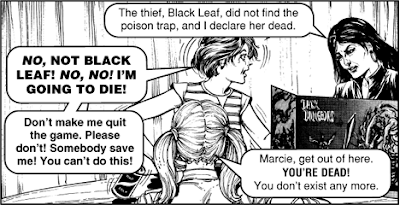
PCs Never Die, They Just Whine Away

For a long time now I have noticed an increasingly popular trend among RPG players on forums such as the ones found at Giant in the Playground or even Paizo Publushing's own forums; and while it may not be a universal truth, I've been seeing it enough to take notice.

There's a fine line between brave and stupid.
The trend is this idea that player characters (PCs) aren't supposed to die. I see it popping up more and more frequently in gaming conversations of all topics (GMing, adventures, campaigns, problem players, how to run good games, etc). I find it popping up everywhere and toted about as if it were common knowledge throughout the gaming community. The absolute worst thing ever must be the death of a player character.

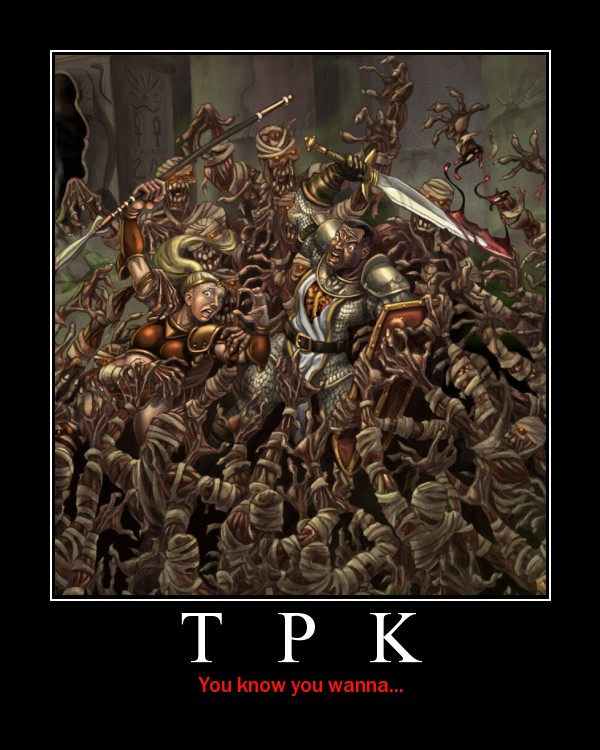
But wait! There is one monstrosity spoken of that rivals if not exceeds the dreaded PC death, and that is the even more dreaded TPK (total party kill); where the entire adventuring party meets their demise at the hands of some terrible monster or unfortunate end; ending the campaign and the world as we know it. The horror!

Ok, so obviously I'm being a little sarcastic in my delivery of the theme, but that's the gist of it. I keep noticing that in these games where PCs are in constant life or death struggles, people are getting really testy if a PC actually bites the bullet. In d20 based games like Pathfinder (TM) or the 3.5 Dungeons & Dragons (TM) systems where they have sections of the rules entitled things like Death and Dying, one might think that the chance for a character to die doing something dangerous like waging wars and fighting monsters might be almost expected.

Surely pissing in his cornflakes wouldn't get him that mad!
It seems to me that there's a growing sense of entitlement among gamers today. The idea that player characters aren't supposed to die, or are only supposed to die if it's a "heroic death". Situatons such as players complaining that GMs being unfair because a critical hit killed a player character, and having PCs acting in illogical or outright bizarre because they don't fear that the consequences of their actions could prove fatal.

This growing trend bugs me for the following reasons:
Someone might get this reference...
1) It's very unsporting. I usually think people play games because it's fun and challenging. If you take the chance of risk out of it, it becomes boring fast. It's like going through the motions of playing a game, but the result is already forgone. Imagine playing a cardgame tutorial where you always draw the same cards, and you will always win, because it's just a tutorial and you're not really playing but instead going through the motions. It's kind of like that.

2)
I dislike this sense of entitlement. I'm right on the forefront for PC rights, but this is just silly. I don't advocate using challenges that are beyond your PC's capabilities, and I encourage erring on the side of caution. If you make a mistake as a GM and over estimated your PCs, well apologizing and asking to try again is fine and commendable. However, when an orc warrior rolls a critical hit on his greataxe for 3d12+9 points of damage, don't complain that your GM should have made them wield 1d4+3 daggers or tell him he shouldn't count the critical hit. That doesn't sound much like a good gamer (it sounds kind of whiny actually).

3) If you don't want to play the game, why are you? When my friends and I sit down to play a good game of Pathfinder(TM), we know that our GM will try his best to give us a good game with fun challenges, interesting characters to interact with, maybe a puzzle or two, and a glimpse at heroic action. We'll try to reduce the chances of our demise. We'll make plans, come up with strategies and ideas, and try not to take unneeded risks. We don't want to be on the receiving end of enemies wielding axes, and we use spells like protection from evil and death ward to guard against mind-control and instant-death effects. If our players live, we feel a sense of great success; if they die, we roll new characters and explore a new adventure (or the same adventure through different eyes, occasionally).

This is not how the game is supposed to be played.
4) It makes us sound crazy. I was running a game online and a player begged me not to have a shadow attack his character because his character could die. Another played in an online game I was running, a group of 4 players (1 wizard, 1 witch, 1 fighter, 1 cleric) ended up attracting the attention of zombie guards who were physically very strong and tough but incredibly slow, and the wizard and the witch both ran into melee to cast shocking grasp and burning hands on the monsters who, being strong and tough, didn't fall down. The player playing the witch begged for a "deux ex machina" (Deus ex machina is a god introduced into a play to resolve the entanglements of the plot) to save the PCs from their mistakes. Sheesh, roll up a new character. If you're so attached to this fictional character, you probably shouldn't be having them out on dangerous adventures, fighting man eating monsters, and getting fireballs tossed at them.

This adventure is awesome and hard.
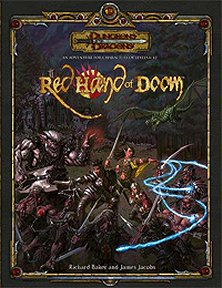
There's also the fact this seems to be a relatively new occurrence. Looking back on classic Dungeons & Dragons (TM) modules from the 70s, 80s, 90s, and even more recent adventures such as The Red Hand of Doom, we can see that challenges exist and are meant to be real. Player characters died. The Red Hand of Doom openly says it expects PCs to die and the players could possibly find a rod of resurrection with a couple of charges left early on, but those charges can get used up fast. Some classic modules or older editions sometimes suggested making extra characters that could be pulled into the story quickly to replace a PC that dies.

I've been playing D20 based fantasy RPGs since Dungeons & Dragons(TM) 3rd Edition was released in 2000. I spent a great deal of time on the internet on forums of all kinds discussing my favorite game. This seems to me like a rather recent occurrence in the past several years.

My Thoughts: I think that this attitude is really a negative thing in the gaming community. While not assuredly a problem in every group, the idea that playing the game as it was intended to be played is wrong strikes me the wrong way. It may sound elitist (or perhaps philosophical) but I think it's important to learn from your mistakes. When you run up to a giant and decide to poke it with your sword, and he turns you into pudding, then you'll learn not to do that next time. You can learn from your mistakes. Maybe you find yourself in a situation where you're outnumbered or outmatched; maybe you should retreat and find another solution.

Even if your PC dies, you can always grab some more dice (or your point-buy chart) and roll a new one. Give life to a new character. Try something new, something fun, or just try again. Nothing lost, nothing gained.